


The cozy cave of social media
- Lexi Harned
- Apr 12, 2017
- 3 min read

Everyone likes to stay in their own comfortable bubble. If someone else gets let into their bubble, its purely because they were accepted in. It can be nearly impossible to be apart

of a person's space when you do not believe what they believe.
On a social media standpoint, you can be blocked, deleted, or bullied for not agreeing with someone else. But you got into their space, knowing that you do not agree, what else could you expect? Confirmation bias is a real and inescapable force that is all over social media. It can promote endless fake news, conspiracy theories, social media wars, and even physical violence. Most of it of course is a big fat lie and yet it still gets share after share.
Most of the confirmation bias issues on social media tends to be because of politics, especially after elections. Social media users are practically split into a few categories; democrat or republican and progressive or conservative. People usually follow accounts that are run by people that have the same political views as them and can confirm that their beliefs are true.
For example, If someone is pro-choice, most of their followers or the people that they follow are going to be pro choice too. We do not want outsider opinion, we want to believe that everything we agree with is true.

We scream into a void and expect nothing but confirmation in return. This instance is usually called echo chambers, and it is often what actually happens on social media. We put ourselves in these comfort zones that often go unnoticed.
Political stir on social media can also result in fake news publishing's which can cause massive paranoia and violence. Once someone puts a fake article or story on Facebook or twitter it spreads like wildfire and can ruin lives and businesses.
#Pizzagate is a fake conspiracy theory that proclaimed Hilary Clinton to be behind a child sex slave operation under a pizza place in Washington, D.C. It spread instantly on social media and had conservatives and had some Trump supports behind it without even opening up the article.
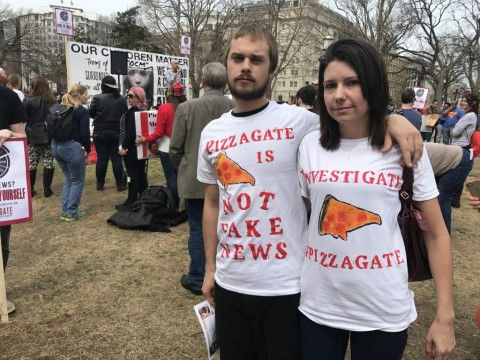
It caused one man to be so paranoid for his children that he went into the pizzeria with a gun and demanded to be taken to the basement. The pizza place does not even have a basement. That's how crazy this theory was, and how scary it became for the owner and his business.
According to the New York Times, the owner, James Alefantis said "These lies and falsehoods spread about me and my restaurant exist all over. The damage that has been done to my company and my community, all will remain forever."
There have been many different studies done to try and confirm that confirmation bias is a real thing. A number of studies at Stanford were faked to try and prove that people will continue to believe what they believe, even if there is
no factual evidence that it is true.

In 1975 Stanford conducted a study where students were asked to identify if a suicide note they were given were real or fake. The researchers told the first group that they got most of them right, and the second group that most of them were wrong. The first group believed that they were really good at identifying the real one, getting 24 out of the 25 notes right. The rest of the students thought they did poorly at guessing the actual suicide note, only getting about 10 right. Even after the researchers told the students that the point of the study was to sway the way they think, the students still believed that they were either really good, or really bad at identifying which notes were real.
The facts can be right in front of us. We still probably will not believe it. I still get into arguments on Facebook about issues that I passionately agree with. But some of my family will do everything in their power to make me see their side of it, but I just can't. Right now confirmation bias is impossible to steer clear from. We can't help but want to feel validation for something that we truly believe, so we always go searching for it, and probably always will.
Comments